
Direct Traffic vs. Organic Traffic: The Difference I Was Getting Wrong
For a long time, whenever I opened my analytics dashboard and saw traffic going up, I was happy.
More traffic meant growth.
Or at least, that’s what I thought.
I remember looking at one particular spike in direct traffic and immediately trying to explain the success.
Maybe more people were remembering the website.
Maybe the brand was getting stronger.
Maybe people were coming back directly because something we were doing was finally working.
It was a nice story.
There was just one problem.
I couldn’t actually prove any of it.
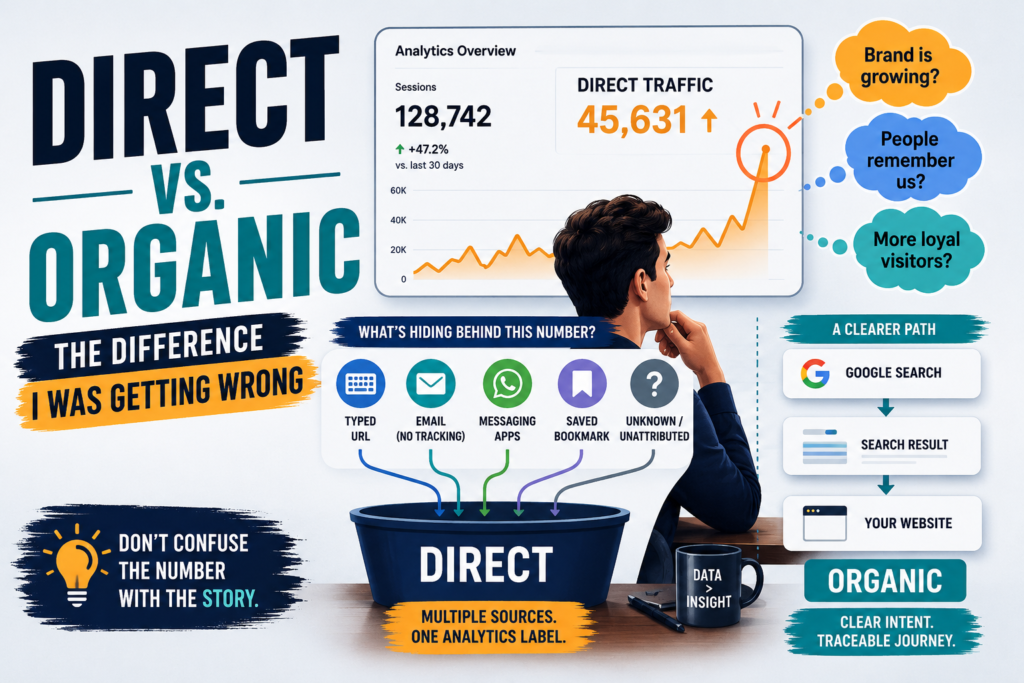
Some of those visitors could have typed the URL directly into their browser.
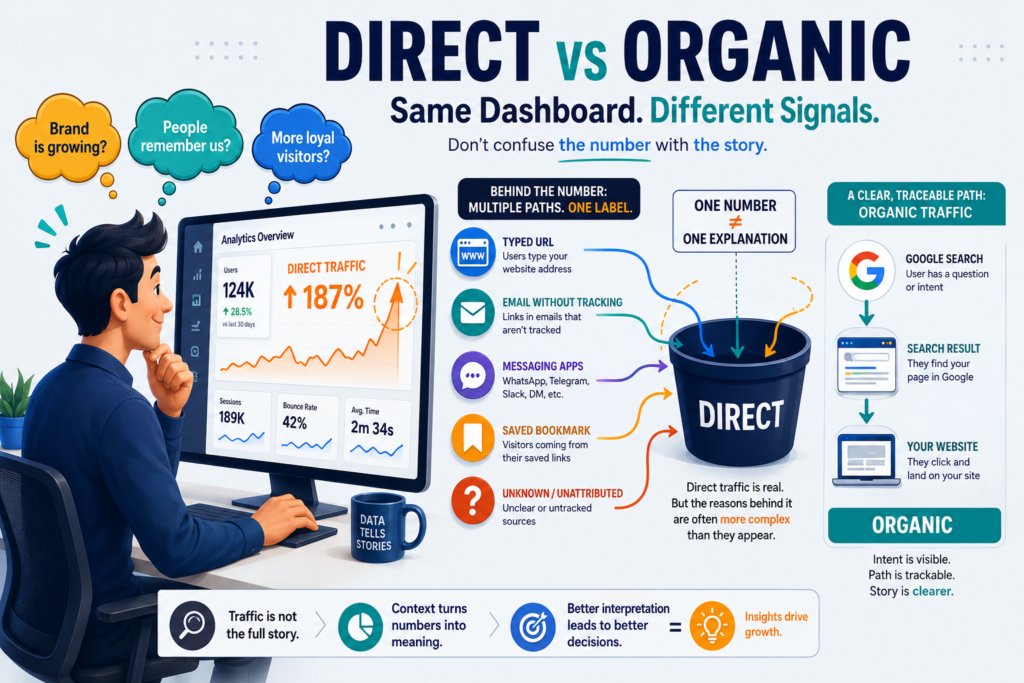
But others could have come from an untagged email, a messaging app, a saved bookmark, or another source that analytics simply couldn’t identify properly.
That realization changed how I looked at one of the most basic reports in analytics:
Direct traffic vs. organic traffic.
Because these two numbers may sit next to each other in your analytics dashboard, but they tell you very different things.
And if you interpret them incorrectly, you can make surprisingly bad growth decisions from perfectly accurate-looking data.
Here’s how I think about them now.
What is direct traffic?
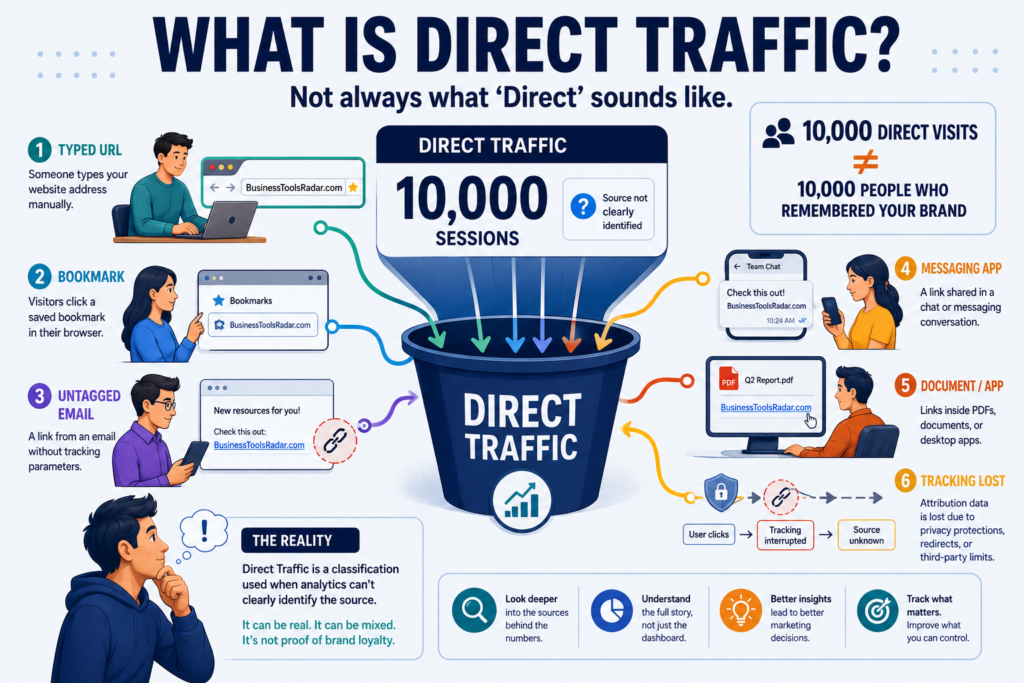
The simplest explanation is that direct traffic represents visitors who arrive at your website without a clearly identifiable referring source.
The classic example is someone typing your URL directly into their browser.
If someone already knows BusinessToolsRadar.com, types the address, and visits the website, that can appear as direct traffic.
Bookmarks can also generate direct visits.
That sounds straightforward.
But this is where things get interesting.
Not everything classified as direct traffic necessarily came from someone deliberately typing your website address.
Analytics platforms sometimes classify visits as direct when they simply cannot determine where the visitor actually came from.
That can include traffic from things like:
- Untagged email links
- Messaging applications
- Saved bookmarks
- Some documents or applications
- Privacy-related tracking limitations
- Improperly tagged marketing campaigns
So when you see:
Direct Traffic: 10,000 sessions
You cannot automatically translate that into:
10,000 people remembered my brand and came back.
Some might have.
Some might not have.
That distinction sounds small until you start making business decisions based on it.
I learned that the hard way.
The traffic spike I almost celebrated for the wrong reason
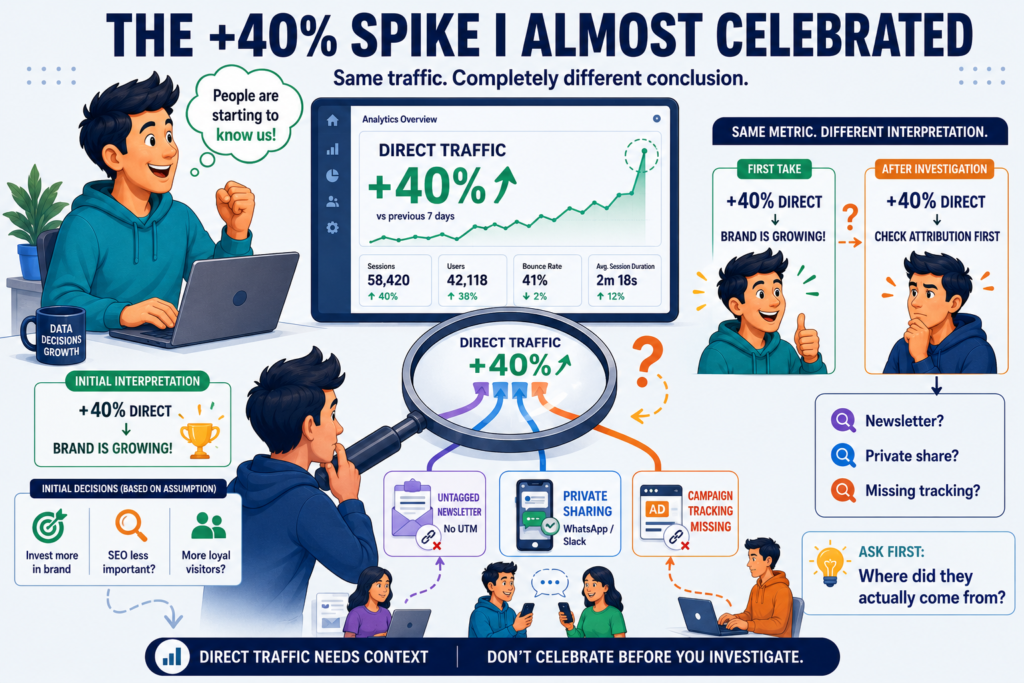
Imagine opening your analytics one morning and seeing direct traffic suddenly jump 40%.
That feels good.
Your first instinct might be:
“People are starting to know us.”
And if you believe that explanation, your next decisions follow naturally.
Maybe you invest more heavily in brand campaigns.
Maybe you assume your existing audience is returning more frequently.
Maybe you deprioritize SEO because discovery appears less important now.
But before doing any of that, there’s a much more useful question:
Where did these people actually come from?
Maybe you sent a newsletter yesterday without proper UTM parameters.
Maybe someone shared your article inside a private WhatsApp or Slack group.
Maybe a campaign wasn’t tagged correctly.
Suddenly, what looked like evidence of stronger brand demand becomes an attribution problem.
Same traffic.
Completely different business conclusion.
That’s why I no longer look at direct traffic as automatic proof of loyalty.
I treat it as a signal that needs context.
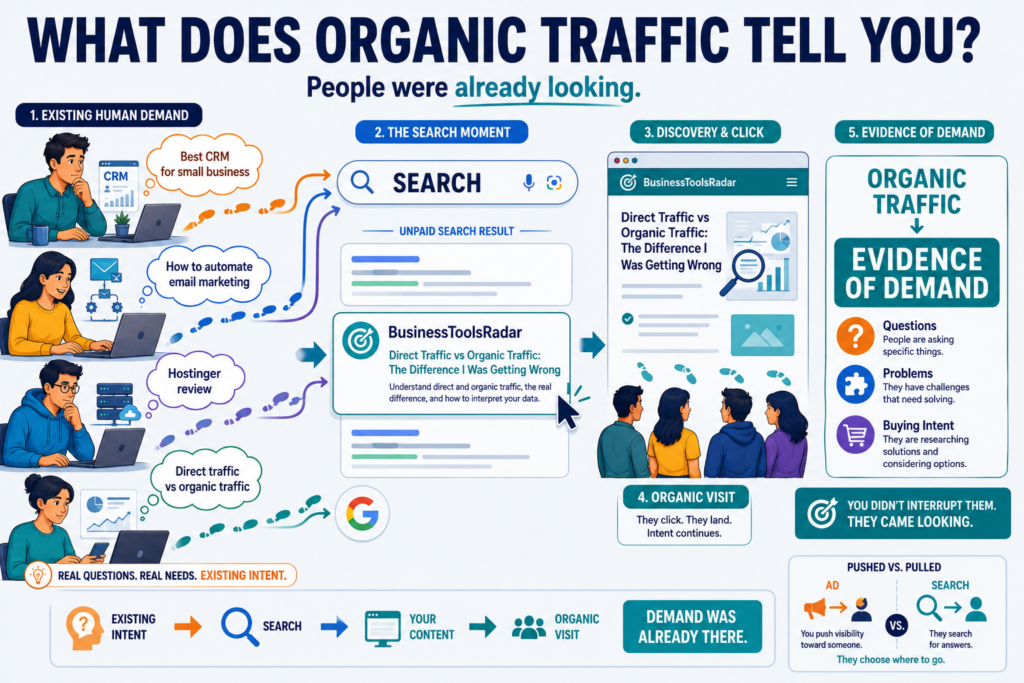
So what does organic traffic tell you?
Organic traffic is much easier to understand conceptually.
Someone searches for something.
They find your website in unpaid search results.
They click.
That visit becomes organic traffic.
But I think the more interesting distinction is why that person arrived.
They were already looking for something.
Maybe:
“best CRM for small businesses”
or:
“How to automate email marketing”
or:
“Hostinger review”
or even:
“direct traffic vs. organic traffic”
You didn’t interrupt them with an advertisement.
You didn’t necessarily push the article into their social feed.
They had a question, problem, need, or curiosity.
Then they went looking for an answer.
And somehow, your website became part of that search.
That makes organic traffic incredibly useful.
Not just as traffic.
As evidence of demand.
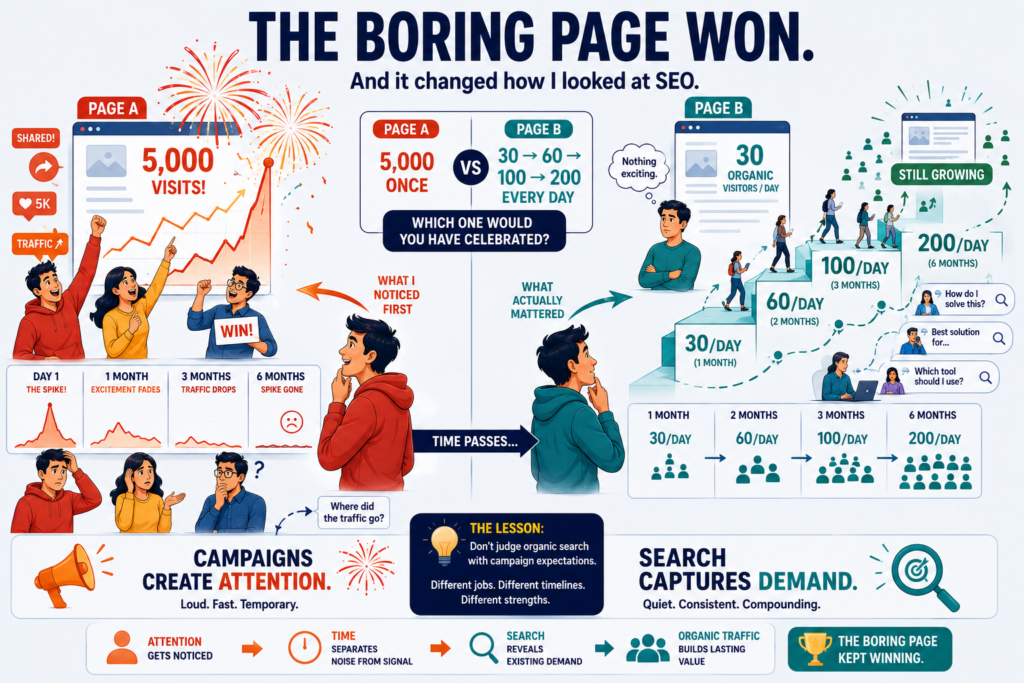
The boring page that changed how I looked at SEO
I once made the mistake of judging content too quickly.
Imagine two pages.
Page A suddenly gets 5,000 visits after being shared somewhere.
The graph shoots upward.
Everyone notices.
Page B gets only 30 organic visitors a day.
Nothing exciting happens.
No dramatic spike.
Just:
Month after month.
Which page feels more successful?
Page A.
Obviously.
Except six months later, the spike has disappeared.
Meanwhile, Page B has quietly climbed from 30 daily visitors to 60.
Then 100.
Then 200.
And those visitors keep arriving because people continue searching for the problem that page solves.
That’s when SEO started making more sense to me.
I had been judging organic traffic like campaign traffic.
But organic traffic often behaves differently.
A campaign creates attention.
Search captures existing demand.
Those are not the same job.
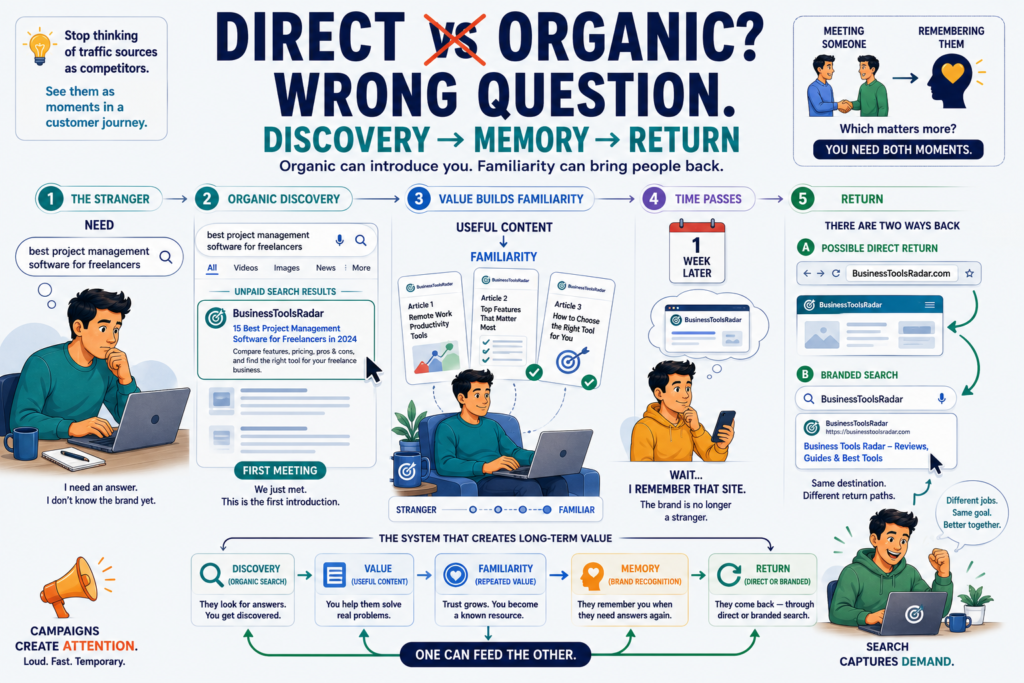
Direct traffic vs. organic traffic isn’t really a competition.
People often ask:
“Which is better, direct traffic or organic traffic?”
I think that’s the wrong question.
It’s a bit like asking:
What’s more important: meeting someone or having them remember you afterward?
You need both.
Organic traffic often helps people discover you.
Direct traffic can sometimes be associated with people returning to you, although direct attribution alone cannot prove that.
Think about how someone might discover a website.
They search:
“best project management software for freelancers”
They find your article.
That’s organic discovery.
They read three more articles.
A week later, they remember your brand.
Eventually, they type your website name directly into their browser or search specifically for your brand.
Now you potentially have a returning visitor with stronger brand awareness.
That journey is much more interesting than asking whether organic or direct “won.”
One can feed the other.
Discovery creates familiarity.
Familiarity can create memory.
Memory can create return behavior.
That’s the system I care about.
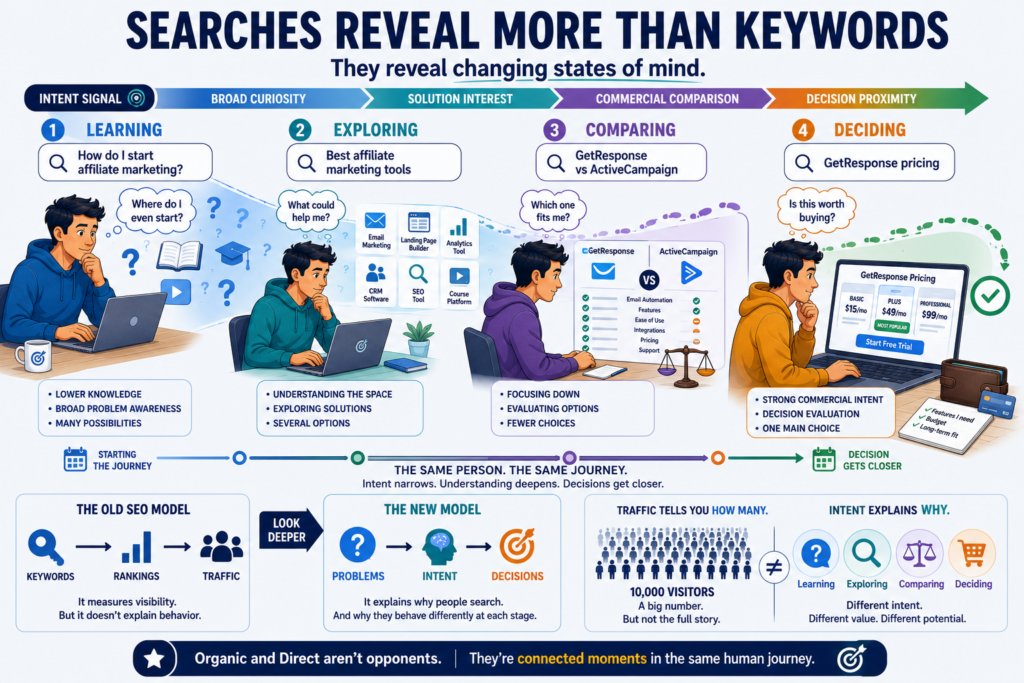
What organic traffic can reveal about demand
This is probably the biggest reason I pay attention to organic search.
Search behavior aims for intent.
People literally tell search engines what they want.
They ask:
“How do I start affiliate marketing?”
Then later:
“best affiliate marketing tools”
Then:
“GetResponse vs ActiveCampaign”
And eventually:
“GetResponse pricing”
Those aren’t four random keywords.
They’re four different states of mind.
The first person is learning.
The second is exploring solutions.
The third is comparing.
The fourth may be close to buying.
Once I understood this, I stopped looking at SEO as simply:
Keywords → Rankings → Traffic
I started seeing:
Problems → Intent → Decisions
That’s a much more useful way to think about organic traffic.
Because 1,000 visitors searching for something directly related to your business can be far more valuable than 10,000 visitors who arrived with no meaningful intent.
Traffic volume tells you how many people arrived.
Intent helps explain why they came.
The dashboard mistake that’s incredibly easy to make
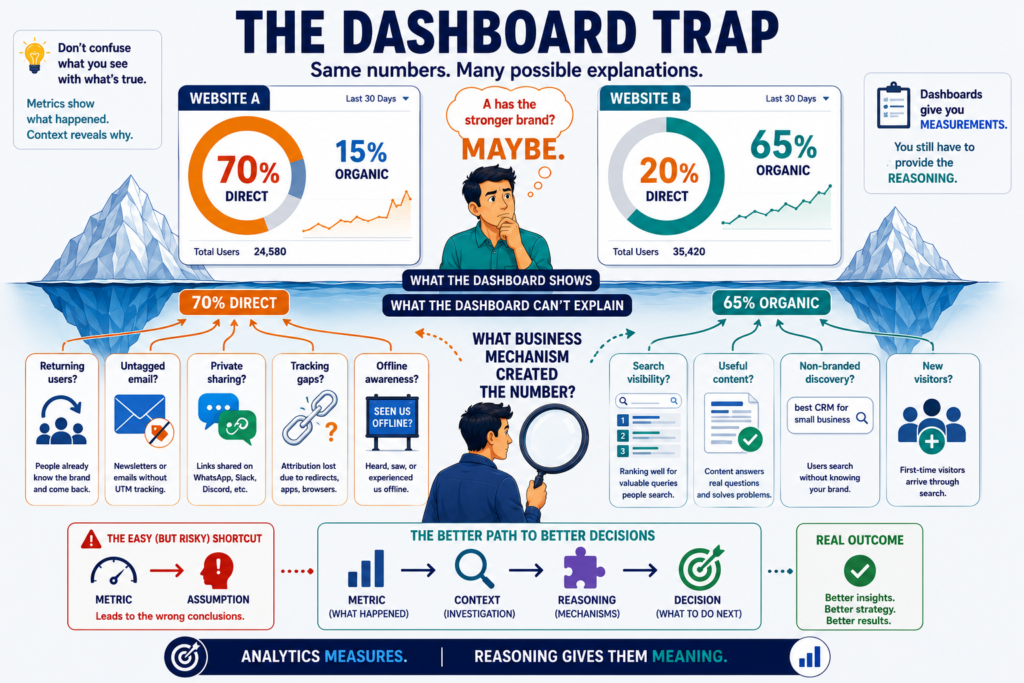
Suppose you’re comparing two websites.
Website A
Direct traffic: 70%
Organic traffic: 15%
Website B
Direct traffic: 20%
Organic traffic: 65%
At first glance, you might conclude:
Website A has a stronger brand.
Maybe.
But you don’t know that yet.
Website A could have:
- A large returning audience
- Heavy email traffic without proper tagging
- Significant private sharing
- Attribution problems
- Strong offline awareness
Website B could have:
- Excellent search visibility
- Strong informational content
- High non-branded discovery
- Thousands of first-time visitors entering through Google
Neither traffic mix is automatically better.
The question is:
What business mechanism created those numbers?
That’s the question dashboards can’t answer for you.
Analytics gives you measurements.
You still have to provide the reasoning.
Why direct traffic feels more exciting than it sometimes deserves
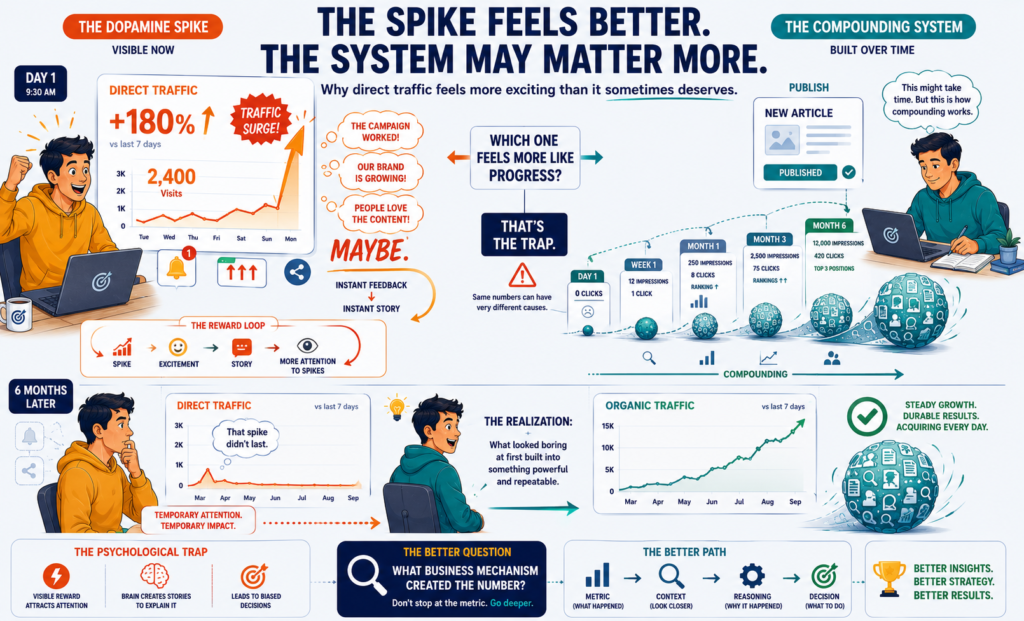
There’s also a psychological trap here.
Spikes feel like progress.
Open your dashboard.
Traffic suddenly jumps.
Your brain immediately wants a story explaining why.
“The campaign worked.”
“Our brand is growing.”
“People love the content.”
Maybe.
But human beings are very good at creating explanations after seeing a result.
Organic growth often doesn’t provide the same emotional reward.
You publish an article.
Nothing happens.
A few impressions appear.
Then a few clicks.
Rankings slowly improve.
Three months later, traffic starts moving.
Six months later, the page might become one of your biggest acquisition channels.
There was never one dramatic moment to celebrate.
It just compounded.
That’s one reason marketers can become addicted to spikes while underinvesting in systems.
The spike is visible.
Compounding is boring until it isn’t.
How I think about direct and organic traffic now
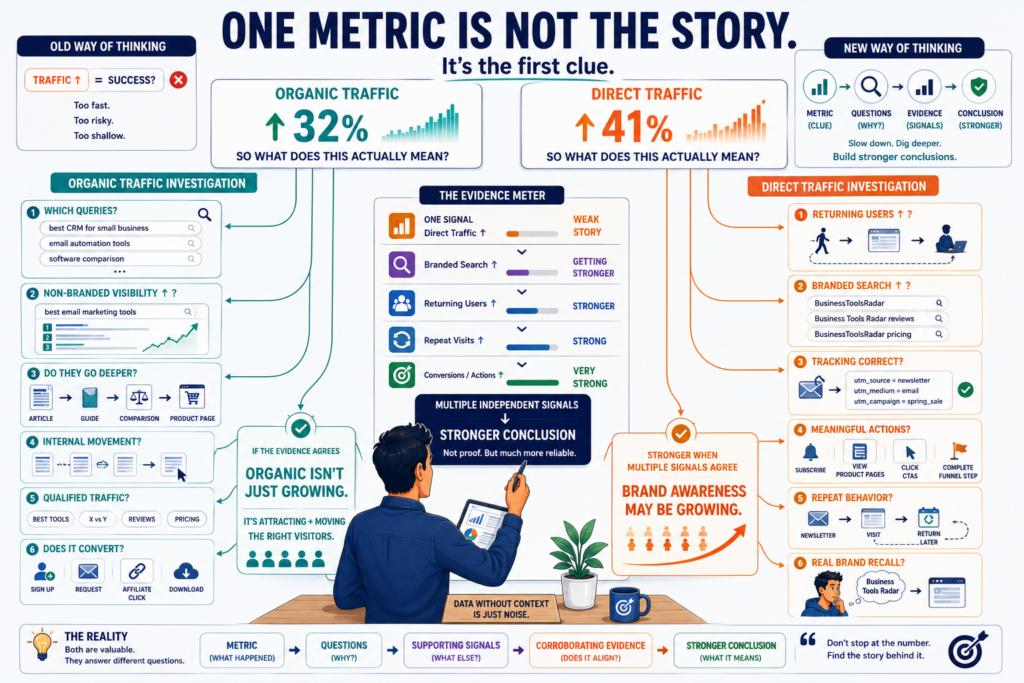
I don’t judge either channel from traffic volume alone anymore.
For organic traffic, I want to know:
- Which queries are bringing visitors?
- Is non-branded search visibility growing?
- Are visitors finding deeper pages?
- Are they clicking internal links?
- Are commercial-intent pages receiving qualified traffic?
- Are visitors eventually converting?
For direct traffic, I want more context.
- Are returning users increasing?
- Are branded searches increasing?
- Are email and campaign links tagged correctly?
- Are people completing important actions?
- Is there evidence that brand awareness is actually growing?
That last distinction matters.
If direct traffic increases, I don’t immediately say:
“Our brand is stronger.”
I ask:
“What other evidence would confirm that?”
Maybe branded search volume increased.
Maybe returning users increased.
Maybe newsletter subscribers increasingly revisit the website.
Maybe more people search specifically for the company or product name.
Now the story becomes stronger.
One metric rarely deserves to tell the entire story by itself.
Why high direct traffic with no discovery can become a warning sign
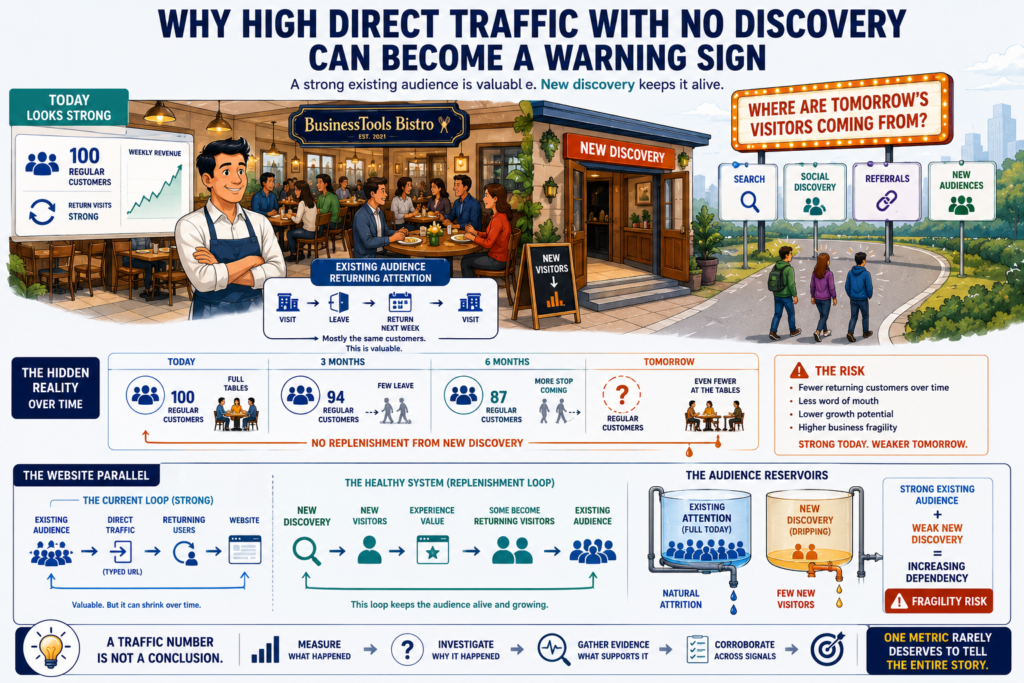
Imagine running a restaurant where the same 100 customers visit every week.
That’s a good business.
Until some of them stop coming.
If nobody new is discovering the restaurant, eventually the customer base shrinks.
Websites can face a similar problem.
A strong existing audience is valuable.
But if discovery stops growing, you’re increasingly dependent on people who already know you.
That’s why I become cautious when I see a website with strong returning or direct activity but weak acquisition from search and other discovery channels.
The question becomes:
Where are tomorrow’s visitors coming from?
Existing attention can sustain a business.
A new recovery expands it.
You usually need both.
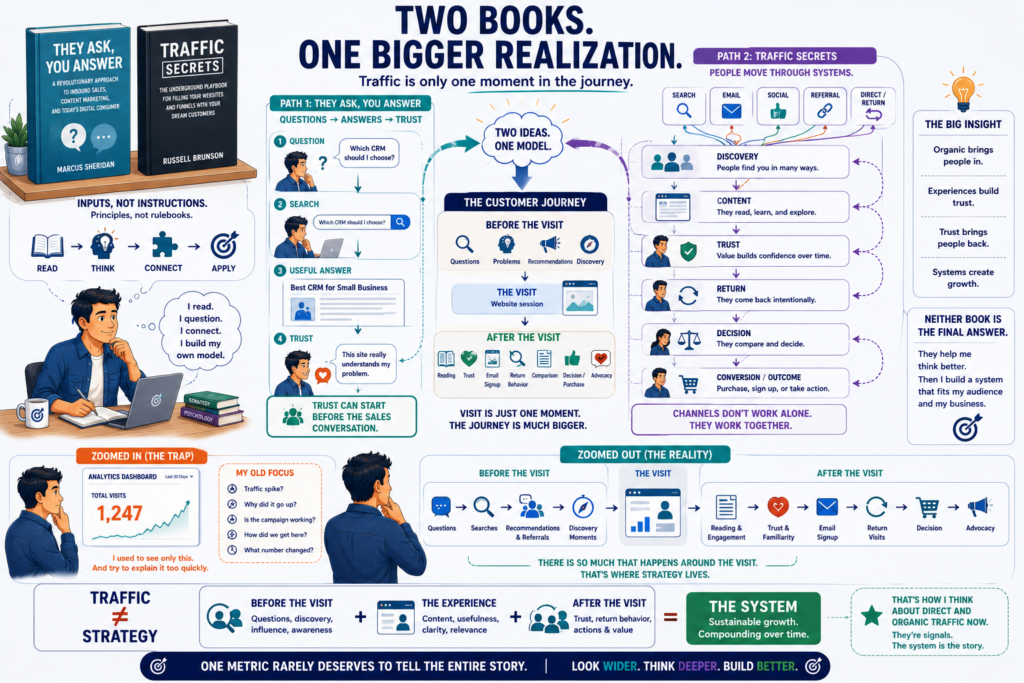
Two books helped me connect these ideas.
Two books influenced how I eventually thought about this.
They Ask, You The answer reinforced a simple idea:
People search because they have questions.
The businesses willing to answer those questions clearly can earn trust before a sales conversation ever happens.
Traffic Secrets helped me think less about isolated traffic channels and more about how people move through an ecosystem.
I wouldn’t treat either book as a rulebook.
Marketing changes too quickly for that.
But together they reinforced something I think many marketers miss:
Traffic isn’t the strategy.
What happens before and after the visit is the strategy.
What good marketers seem to understand
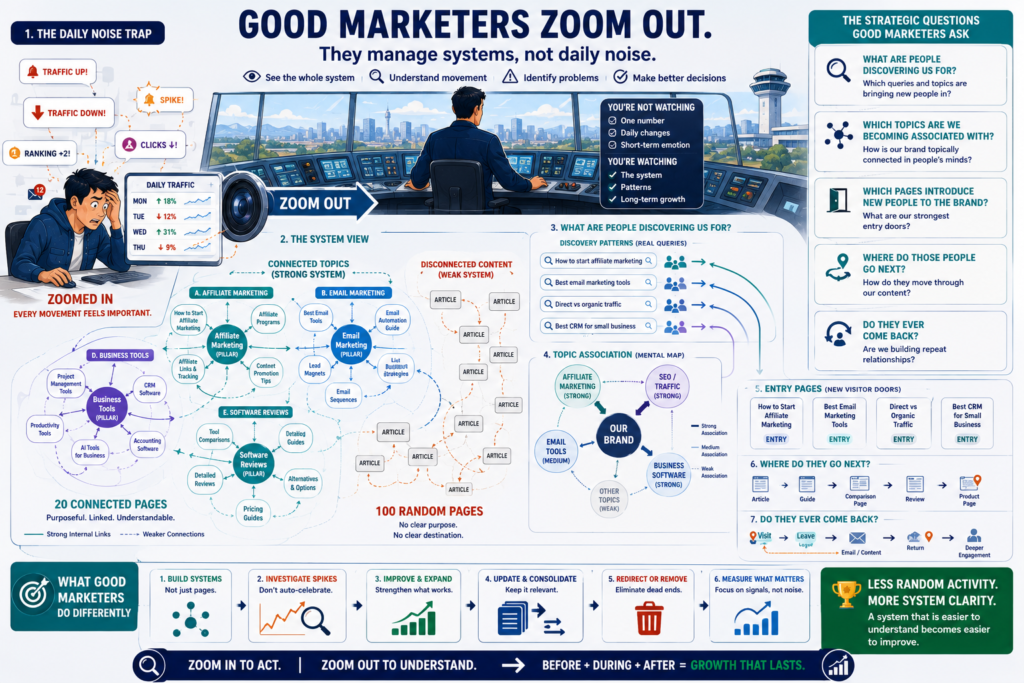
The strongest marketers I’ve observed don’t obsess over every daily traffic fluctuation.
They zoom out.
They ask:
What are people discovering us for?
Which topics are we becoming associated with?
Which pages introduce new people to the brand?
Where do those people go afterward?
Do they ever come back?
That leads to very different behavior.
Instead of publishing 100 disconnected articles, they might build 20 deeply connected ones.
Instead of celebrating every traffic spike, they investigate where it came from.
Instead of keeping every old article alive forever, they update, consolidate, or remove content that no longer serves a purpose.
It looks less exciting.
But the system becomes easier to understand.
And therefore easier to improve.
When direct traffic can matter more
I also don’t want to create the opposite misconception.
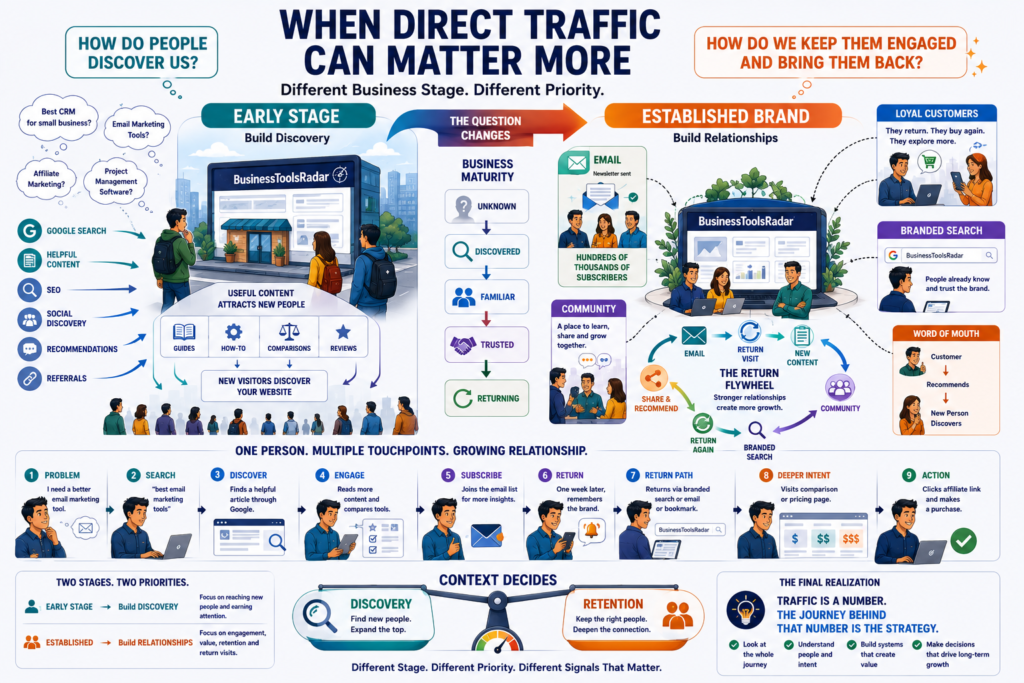
Organic traffic is not automatically more valuable than direct traffic.
Imagine you already run a well-known brand.
You have: The answer
- Hundreds of thousands of email subscribers
- Loyal customers
- Strong word-of-mouth
- High branded search demand
- A community that regularly returns
In that situation, direct and returning behavior is enormously important.
You don’t need every customer to discover you through a generic Google search.
They already know you.
The strategic question changes from
“How do people discover us?”
to:
“How do we keep them engaged and bring them back?”
Different business stage.
Different priority.
That’s why there’s no universally “best” traffic source.
Context decides.
The distinction that finally changed how I read analytics
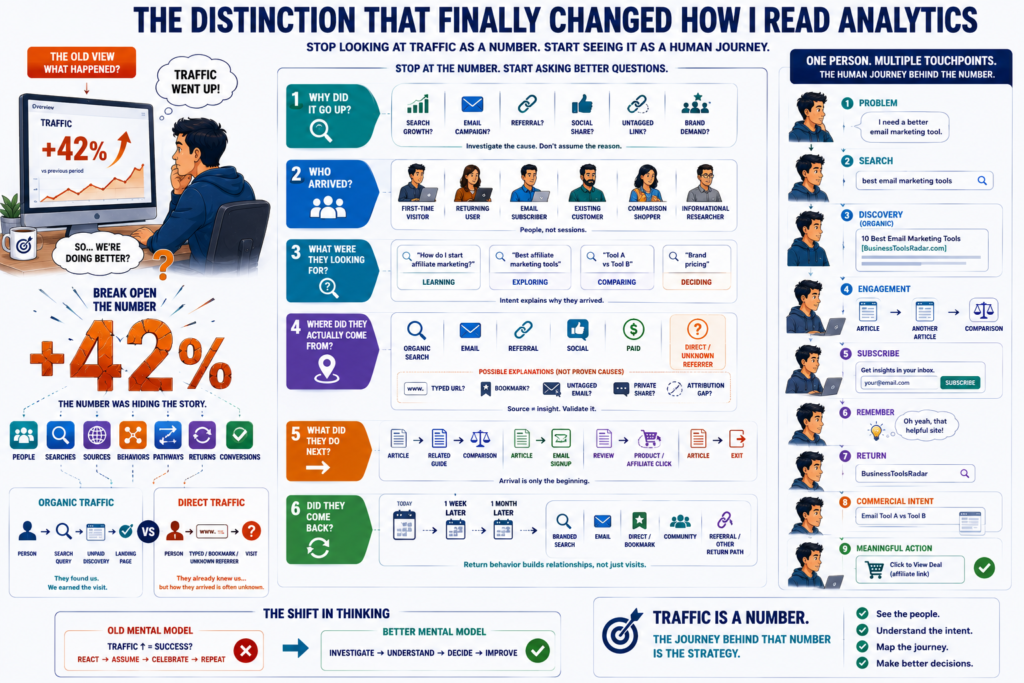
I used to open analytics and ask:
Did traffic go up?
Now I think that’s one of the least interesting questions.
I want to know:
Why did it go up?
Who arrived?
What were they looking for?
Where did they actually come from?
What did they do next?
Did they come back?
Those questions changed how I think about direct traffic vs. OV-ANic traffic.
Organic traffic can show you how people discover you through search.
Direct traffic tells you that analytics didn’t identify a referring source, which may include genuine direct visits but shouldn’t automatically be interpreted as brand loyalty.
And when you combine traffic-source data with branded search, returning-user behavior, engagement, conversions, and proper campaign attribution, you start seeing something much more useful than a traffic chart.
You start seeing how people move through your business.
That’s ultimately what analytics is supposed to help you understand.
Traffic is a number.
The journey behind that number is the strategy.