Most online businesses don’t fail because the product is bad.
They fail because no one ever sees it.
That’s the quiet reality most beginners run into after building a funnel, setting up an affiliate link, or publishing content that goes nowhere. Traffic becomes the bottleneck. And when traffic becomes the bottleneck, people start looking for anything that promises movement.
BullRush Traffic exists in that exact moment.
It is a low-ticket traffic training course created for people who already have something to promote, but no consistent way to bring visitors to it. This page explains what BullRush Traffic actually teaches, what it does not do, who it helps, and where it breaks down.
It’s a reality check.
Traffic training often attracts beginners who have already tried “one last method” that didn’t work. The patterns described on this page come from observing how entry-level marketers typically struggle with visibility, consistency, and follow-through in real situations—not from theory or ideal scenarios. These issues show up repeatedly regardless of niche, platform, or offer quality.
- What Is BullRush Traffic
- Vendor Background: What the Longevity Actually Tells You
- What he is training n Problem Is he Trying to Solve
- How BullRush Traffic Actually Works
- Who this program Is Most Likely to Help
- Who This Will NOT Work For
- Realistic First 30–60 Day Expectations
- Traffic Ownership vs Dependency
- Where BullRush Traffic Fits in a Real Business Stack
- Comparison With Other Traffic Methods
- Common Reasons People Fail With BullRush Traffic
- Ethical Disclosure
- Final Perspective (Uncomfortable but Honest)
- Launching on 8th Jan 6 am
What Is BullRush Traffic
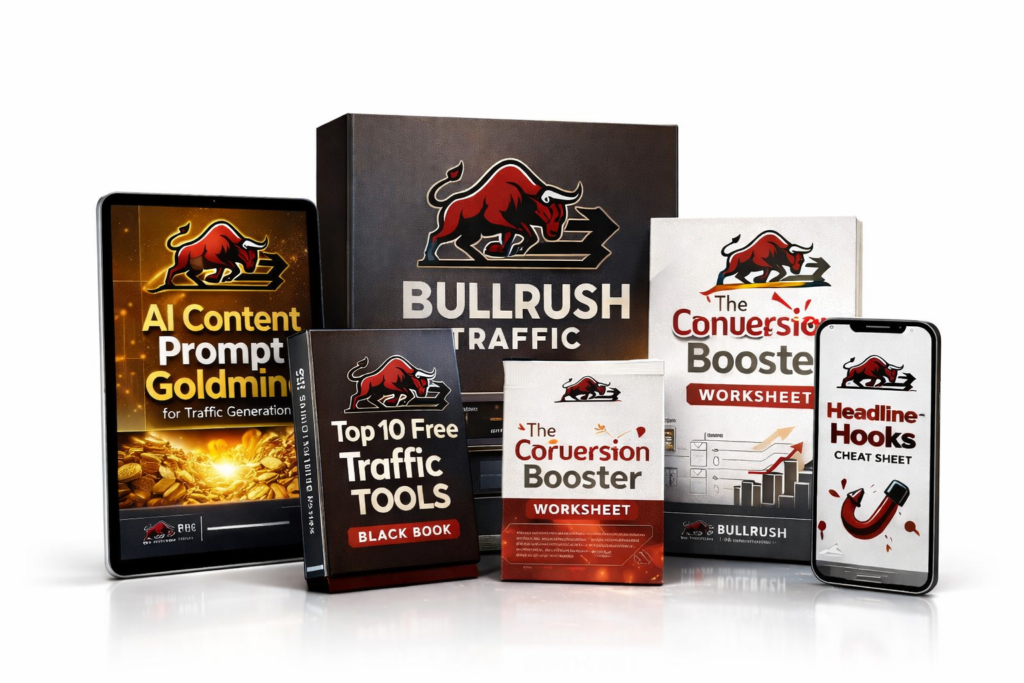
Is a 10-part video training course that teaches beginner-friendly traffic methods across multiple channels.
It does not send visitors to your links.
It does not automate traffic.
It does not “unlock” a hidden traffic source.
Instead, it walks through a variety of traffic approaches such as:
- Affiliate-style promotion methods
- Social and engagement-based traffic
- Content-driven exposure strategies
- Repetition and visibility mechanics
In practical terms, BullRush Traffic explains methods, not outcomes. You still have to choose the channel, create the content, test placement, and follow through consistently.
That distinction matters more than the price.
Vendor Background: What the Longevity Actually Tells You

BullRush Traffic is created by Darren Langdon, a long-time affiliate marketer who has been active in the WarriorPlus ecosystem since around 2010.
Here’s what that realistically means who is darren
- He is not new to launches or traffic training
- He understands how beginners think
- He builds simple, low-friction products rather than platforms
He appears to operate as a solo or very small team rather than a registered platform company. This usually means faster launches and straightforward training, but also limited support infrastructure and no institutional backing.
That’s not a red flag.
It’s a tradeoff.
Should be evaluated as a personal-brand training course, not a company-backed system.
What he is training n Problem Is he Trying to Solve
BullRush Traffic targets a specific set of frustrations that show up early in online marketing:
- Inconsistent traffic that makes income unpredictable
- Dependence on a single platform that can disappear overnight
- Conflicting advice from YouTube, forums, and cheap courses
- Paralysis caused by too many “methods” and no structure
The training attempts to solve this by offering a structured overview of multiple traffic channels, rather than promising mastery of any single one.
This is important to understand.
It is not designed to make you great at one traffic source.
It is designed to help you stop being stuck.
How BullRush Traffic Actually Works
BullRush Traffic works through manual implementation.
What You Must Bring In
- An offer, funnel, or content asset
- Time to test and apply methods
- Willingness to accept uneven results early
What the Training Gives You
- Exposure to multiple traffic approaches
- A framework for testing channels
- Direction instead of random experimentation
Results vary widely. Two people can follow the same training and get completely different outcomes based on offer quality, niche selection, and consistency.
The training does not equalize skill gaps.
It exposes them.
Who this program Is Most Likely to Help
BullRush Traffic makes the most sense for:
- Beginners who need structure, not hacks
- Affiliates with low budgets but time to test
- People overwhelmed by too many traffic opinions
- Users who want to understand traffic before paying for ads
It can also serve as a refresher for experienced marketers, but it is not advanced traffic education.
Who This Will NOT Work For
BullRush Traffic will not work for people who believe:
- Traffic magically fixes bad offers
- Traffic alone creates income
- Follow-up and email lists are optional
- Low-ticket training equals passive income
- ROI is guaranteed if steps are followed
Traffic alone creates nothing if there is no clear offer, follow-up, or conversion path.
Many buyers purchase low-ticket traffic courses because they are afraid of paid ads. BullRush Traffic does not solve that fear. It only postpones it.
Why Traffic Training Fails More Often Than Tools
Traffic training requires interpretation. Two people can watch the same lesson and apply it in completely different ways. Tools fail fast when they don’t work. Training fails slowly, often over weeks of inconsistent execution and misaligned expectations. In many cases, users blame the traffic method itself when the real issue is how the method was applied—or abandoned too early.
Realistic First 30–60 Day Expectations
Days 1–3
- Course access and orientation
- Understanding the traffic framework
- Choosing 1–2 methods to test
Week 1–2
- Initial implementation
- First impressions, clicks, or engagement
- No reliable income data yet, and most users should assume zero revenue at this stage
Week 3–4
- Adjusting messaging and placements
- Identifying what clearly does not work
- Small signs of traction for some users
Month 2
- Clarity on whether these traffic methods fit your niche
- Decision point: double down or move on
This timeline filters unrealistic expectations. Traffic training compounds slowly, not instantly.
Traffic Ownership vs Dependency
What You Own
- Your funnels
- Your email lists
- Your content and accounts
What You Do Not Own
- Any automated traffic stream
- Any proprietary platform or algorithm
If the vendor disappears, you keep the knowledge but lose updates, support, and future revisions. This is typical for low-ticket training products.
There is no platform lock-in, but also no infrastructure safety net.
Where BullRush Traffic Fits in a Real Business Stack
BullRush Traffic does not stand alone.
It fits between these layers:
- Offer or content (must exist first)
- Funnel and follow-up (must exist alongside)
- Traffic training (BullRush Traffic)
- Scaling decisions (ads, SEO, partnerships)
Used correctly, it informs better decisions later. Used alone, it stalls.
Comparison With Other Traffic Methods
The comparison below is not about which method is “better,” but about what kind of dependency and learning curve each creates.
| Method | Setup | Intent | Scalability | Long-Term Independence |
| BullRush Traffic | Low–Medium | Variable | Medium | High |
| Solo Ads | Low | Variable | Medium | Low |
| Paid Ads | High | High (if done well) | High | Medium |
| Free Traffic | Medium | Variable | Medium | High |
BullRush Traffic does not replace paid advertising or list-building strategies. It functions best as an education layer that informs those decisions.
Common Reasons People Fail With BullRush Traffic
Most failures come from execution errors, not the training itself:
- Sending traffic directly to offers
- No email follow-up
- Expecting sales from minimal clicks
- Promoting weak or irrelevant offers
- Ignoring data and repeating mistakes
More training does not fix these mistakes. Awareness does.
Ethical Disclosure
This page may contain affiliate links. If you choose to purchase through them, a commission may be earned at no additional cost.
This analysis does not promise results. Readers should evaluate BullRush Traffic based on their own experience level, risk tolerance, and willingness to implement.
Most people don’t need more traffic strategies. They need fewer strategies executed long enough to see what breaks.
Final Perspective (Uncomfortable but Honest)
BullRush Traffic is a low-cost entry point into traffic education, not a competitive advantage.
Its usefulness depends almost entirely on how seriously the buyer implements what is taught.
For the right beginner, it can reduce confusion.
For the wrong buyer, it becomes another ignored login.
The difference is not the course.
It’s the person using it.
How This Page Was Created
This guide was created using independent product research, vendor materials, and analysis of how entry-level traffic training programs are typically used by beginners. The goal is to provide clarity around expectations, risks, and practical fit—not to promote guaranteed outcomes or shortcuts.