
- The Affiliate Marketing Landscape in 2026
- Why Affiliate Marketing Still Exists And Why That Matters
- What Has Changed and What Has Quietly Stopped Working
- An Experience Pattern That Keeps Repeating
- Where Attention and Trust Now Come From
- Why Most Affiliates Still Fail N The Real Reasons
- Who Affiliate Marketing Is NOT For in 2026
- Income Reality: Why the Gap Is So Wide
- The Truth About AI in Affiliate Marketing
- How Trust Actually Converts Into Revenue
- What Google and Bing Now Reward Consistently
- If You Were Starting Affiliate Marketing Today
- The Bottom Line
A Reality-Checked Answer for People Who Want Results, Not Reassurance
Affiliate marketing still works in 2026, but not for people who treat it like content production.
It works for people who treat it like operations.
That distinction matters more than ever.
The uncomfortable truth is this: most affiliates are not failing because the model is broken. They are failing because they confuse publishing with positioning, traffic with trust, and activity with progress. The ecosystem has matured, the platforms have tightened, and audiences have become far less forgiving. What remains is a viable business model that rewards clarity, patience, and execution, while quietly eliminating everyone else.
If you are looking for shortcuts, this will disappoint you.
If you are looking for leverage, it may be one of the few models still worth building.
The Affiliate Marketing Landscape in 2026
Affiliate marketing is no longer experimental. It now sits firmly inside the broader performance-marketing economy, alongside paid media, influencer partnerships, and direct brand collaborations.
What has changed is not whether it works, but who it works for.
Audiences today do not lack information. They lack confidence in decisions. Search engines no longer reward pages that merely exist. They reward pages that resolve intent, demonstrate experience, and reduce uncertainty. That shift has quietly reshaped affiliate marketing from a volume game into a credibility game.
Those who adapted survived.
Those who didn’t are still publishing, but no longer compounding.
Why Affiliate Marketing Still Exists And Why That Matters
Strip away the noise, and the fundamentals are still intact.
| Structural Factor | Why It Still Matters |
| E-commerce growth | Online purchasing continues expanding across products and services |
| Performance-based model | Brands only pay when results occur, keeping budgets allocated |
| Buyer psychology | People still rely on trusted guidance to reduce risk |
| Operational simplicity | No inventory, logistics, or customer service overhead |
Affiliate marketing survives because it solves a real problem: decision overload. As choices multiply, recommendations become more valuable, not less.
What Has Changed and What Has Quietly Stopped Working
Many affiliates are still operating on outdated assumptions.
Then vs Now
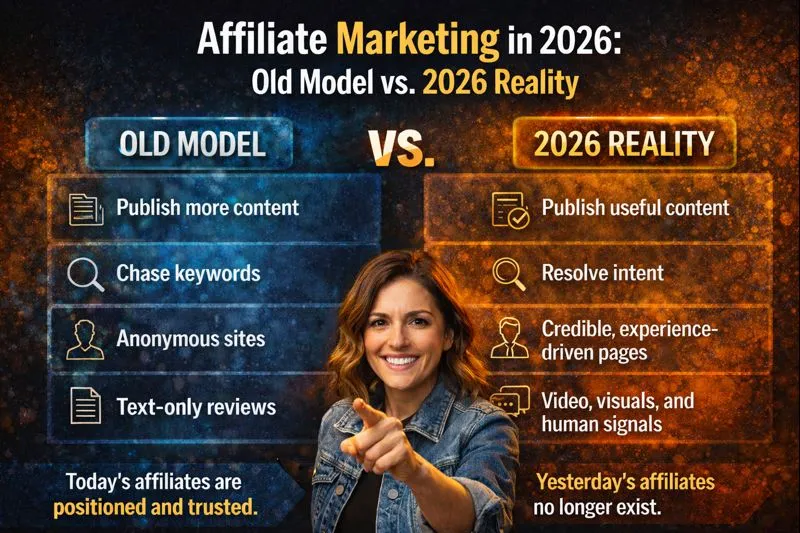
| Old Model | 2026 Reality |
| Publish more content | Publish more useful content |
| Chase keywords | Resolve intent |
| Anonymous sites | Credible, experience-driven pages |
| Text-only reviews | Video, visuals, and human signals |
| Third-party tracking | First-party data and compliant analytics |
Volume without relevance no longer compounds.
Traffic without trust no longer converts.
An Experience Pattern That Keeps Repeating
After reviewing hundreds of affiliate sites over the past few years, one pattern repeats consistently. The sites that survive do not publish more. They publish narrower, deeper, and slower. They focus on fewer problems, fewer offers, and fewer traffic sources, but execute each with more intention.
Most failed sites did not lack effort. They lacked restraint.
They chased too many offers. They copied too many competitors. They optimized for clicks instead of confidence. Over time, that dilution erased trust, and once trust disappears, rankings and revenue follow.
Where Attention and Trust Now Come From
Search still matters, but it no longer works alone.
- YouTube accelerates trust faster than text
- TikTok accelerates discovery and demand
- Email stabilizes traffic against algorithm shifts
- AI accelerates research and execution, not judgment
Modern affiliate traffic behaves like a portfolio, not a single bet.
Sites dependent on one channel grow faster and collapse faster. Sites with diversified attention bend, adapt, and continue compounding.
Why Most Affiliates Still Fail N The Real Reasons
This is where honesty matters.
Most affiliates fail because they:
- Promote products they have not properly evaluated
- Target keywords with traffic but no buying intent
- Rely on automation without understanding fundamentals
- Chase trends instead of building assets
- Quit before trust compounds
This is not a knowledge gap. It is a discipline gap.
Who Affiliate Marketing Is NOT For in 2026
Filtering matters. This model is not universal.
Affiliate marketing is not for:
- Anyone unwilling to research before promoting
- People expecting fast or passive income
- Those who dislike explaining, teaching, or clarifying
- Marketers who avoid data, analytics, or testing
- Anyone uncomfortable adapting to platform changes
If someone feels discouraged reading this, that reaction is a signal, not a flaw.
Income Reality: Why the Gap Is So Wide
Affiliate income is uneven by design. A small percentage earns the majority of revenue, not because of luck, but because of positioning.
What Actually Separates Outcomes
| Affiliate Tier | What They Do | Why They Stay There |
| Bottom tier | Publish generic content, chase trends, promote unvetted offers | No differentiation, no trust, no compounding |
| Middle tier | Target some buyer intent, rely on one traffic source | Plateau due to fragile positioning |
| Top tier | Vet products deeply, focus on one niche, build authority assets | Trust compounds, traffic stabilizes, income scales |
A single SaaS referral paying $20 per month outperforms ten $50 one-time commissions that reset after every launch cycle. This is not theory. It is how compounding works.
The Truth About AI in Affiliate Marketing
Most AI-generated affiliate pages fail in the same way. They look correct but feel empty. They summarize instead of evaluate. They list features instead of consequences. To both users and search engines, they signal aggregation, not experience.
AI works in affiliate marketing only when it accelerates thinking, not when it replaces it.
What still matters cannot be automated:
- What to exclude
- What to warn against
- What disappointed buyers after purchase
- What actually matters long-term
AI can draft. It cannot judge.
How Trust Actually Converts Into Revenue
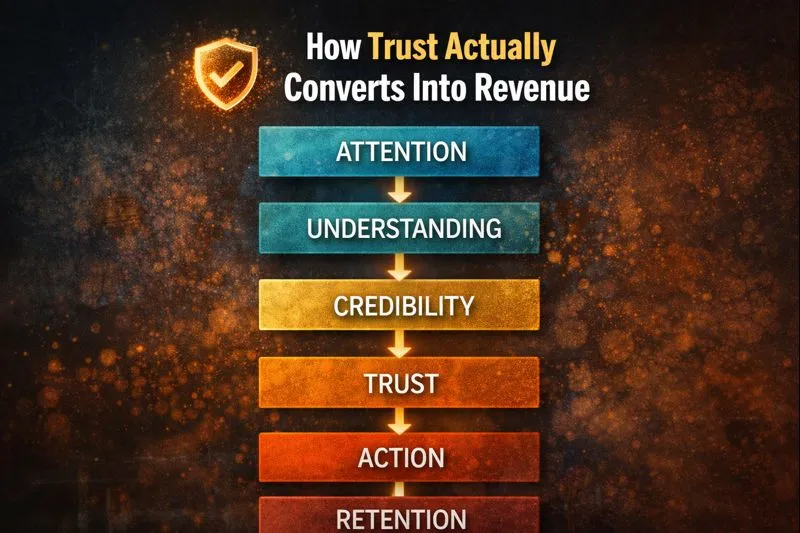
Most affiliates stop at attention.
Revenue lives at retention.
Search engines increasingly reward pages that complete this journey instead of interrupting it.
What Google and Bing Now Reward Consistently
Across updates and platforms, the signals are converging:
- Demonstrated experience
- Clear structure and direct answers
- Honest comparisons and trade-offs
- Human oversight and editorial intent
- Content that reduces uncertainty
Education outperforms persuasion. Transparency outperforms hype.
If You Were Starting Affiliate Marketing Today
Here is a realistic path that works:
- Choose one niche with real problems
- Pick one platform you can sustain
- Commit to one repeatable content format
- Evaluate products before promoting them
- Publish consistently for months, not weeks
No hacks. No shortcuts. Just leverage.
The Bottom Line
Affiliate marketing in 2026 is not dead. And it will never die; as long as there are products and services, affiliate marketing will always be there.
It is refined.
The easy-money narrative is gone. What remains is a legitimate business model that rewards patience, clarity, and integrity. It no longer rewards effort equally. It rewards clarity disproportionately.
If you are looking for reassurance, affiliate marketing will frustrate you.
If you are looking for leverage, it can still reward you slowly and unfairly.
The real question is not whether affiliate marketing works.
The real question is whether you are willing to work the way it now demands.