
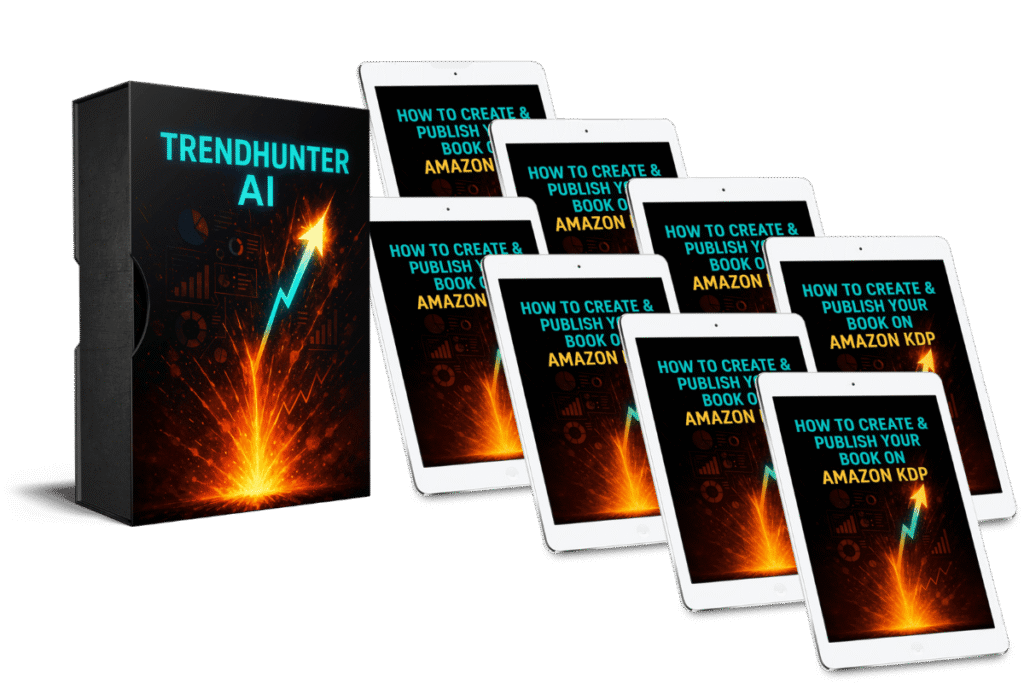
Trend Hunter AI positions itself as an AI-powered tool that helps creators and publishers identify profitable trends before they become saturated.
That claim sits right at the intersection of opportunity and hype.
- What Trend Hunter AI Is
- What Problem Tries to Solve
- How Performs in Real Use
- Where It Is Genuinely Useful
- Where Will Disappoint You
- Input vs Output Reality Check
- Pricing and Purchase Context
- Is Trend Hunter AI Legit or Just Another Launch Tool?
- Pros and Cons
- Who Should Buy Trend Hunter AI
- How It Feels in Actual Use
- Practical Use Cases can be implement
- Where It Falls Short
- Inputs vs Outputs
- How It Compares to Other Research Methods
- Pricing Table
- Simple Explanation of the Pricing
- 🔎 Pricing Clarity
- Final Verdict Honestly
| The product creator | Dave Espino & Shane nathan |
| Product name | Trend Hunter AI |
| Front-end price | $17 (one-time payment) |
| Front-end Salespage | Visit The Product’s Official Salespage |
| Platform | Warrior plus |
| Niche | Amazon KDP |
| Guarantee | 100% Money Back Guarantee |
| Vendor’s Support | dave@daveespino.com |
What Trend Hunter AI Is
Trendhunter AI is a trend discovery and research tool, not an income system.
It aggregates live signals from platforms like Amazon, search trends, and social activity, then applies AI-based scoring to surface topics showing early momentum.
In plain language:
- It helps you decide what to work on
- It does not do the work for you
That distinction matters more than most reviews admit.
What Problem Tries to Solve
Most creators don’t fail because they lack effort.
They fail because they pick the wrong topic at the wrong time.
Common pain points include:
- Publishing into saturated niches
- Guessing demand based on outdated advice
- Spending weeks researching manually
- Realizing too late that interest is declining
Attempts to shorten that cycle by answering:
“Is this topic gaining traction right now, or am I late?”
If that question matters to your business, the tool is at least relevant.
How Performs in Real Use
Let’s talk about actual usage, not sales copy.
What You’ll Notice Immediately
- The dashboard focuses on ranked opportunities, not raw data dumps
- Trends are framed as relative momentum, not absolute guarantees
- Output is designed for decision-making, not automation
This is important: the tool doesn’t overwhelm you with metrics. It nudges you toward actionable judgment calls.
That’s a positive design choice.
Where It Is Genuinely Useful
Based on how the tool is structured, it performs best in these scenarios:
1. Amazon KDP Non-Fiction
If you publish non-fiction books, timing is everything. Trendhunter helps you identify:
- Rising reader interests
- Topics before review-heavy competition dominates
- Sub-niches worth exploring early
This is arguably its strongest use case.
2. Content and Blog Planning
For bloggers and niche site builders, it can:
- Validate topic clusters
- Reduce reliance on lagging keyword data
- Support content calendars tied to rising interest
It’s especially useful when paired with SEO, not used instead of it.
3. Digital Product and Offer Validation
If you create courses, guides, or info products, the tool helps answer:
- “Is this idea aligned with current interest?”
- “Is demand growing or cooling?”
That’s a filter, not a green light.
Where Will Disappoint You
will not work well if:
- You expect it to generate income automatically
- You don’t execute on the insights
- You publish low-quality content
- You rely on it as your only research method
It identifies opportunity signals, not outcomes.
If you treat trend discovery as a shortcut instead of a compass, you’ll be disappointed.
Input vs Output Reality Check
This is where expectations need to be grounded.
You Still Must Provide:
- Topic judgment
- Writing or content execution
- Publishing consistency
- Marketing or distribution
The Tool Provides:
- Ranked trend ideas
- Momentum signals
- Reduced research time
- Better timing confidence
If you already understand this, you’re the right kind of buyer.
Pricing and Purchase Context
Is sold via a low front-end price, typical of the WarriorPlus ecosystem, with optional upgrades.
This pricing structure signals two things:
- It’s meant to be accessible
- The real value depends on how you use it, not how much you pay
Low price does not mean low responsibility.
It means lower financial risk, not lower effort.
Is Trend Hunter AI Legit or Just Another Launch Tool?
This is a fair question.
The vendor behind TrendHunter AI has a long, traceable history in online education and marketing, with real businesses, Dave Espino, and no visible pattern of disappearing after launches.
The technical side is also handled by Shane Nathan with deep platform-level experience.
That does not make the product perfect.
It does reduce the likelihood of it being a disposable cash grab. Learn more about trend hunter ai.
Pros and Cons
Pros
- Saves time on trend research
- Surfaces early-stage opportunities
- Useful for KDP and content creators
- Low entry cost
- Encourages data-driven decisions
Cons
- No guarantees of success
- Requires execution and skill
- Not a replacement for SEO or quality content
- Sold with launch-style upsells
- Trend signals can still change
Who Should Buy Trend Hunter AI
You should consider it if:
- You publish content regularly
- You care about timing and demand
- You want faster validation of ideas
- You understand tools don’t replace work
You should skip it if:
- You want automated income
- You don’t create content
- You expect certainty instead of probability
- You don’t act on insights
How It Feels in Actual Use
My First Impression
The interface is built around ranked opportunities, not raw metrics. You’re not drowning in spreadsheets or dashboards.
This is intentional.
The tool is clearly designed for:
- Non-technical users
- Creators who want direction, not analytics overload
That design choice is a strength and a limitation.
What the Tool Emphasizes
- Relative momentum over absolute numbers
- Trend direction over historical dominance
- Opportunity framing rather than competition fear
You’re encouraged to think in probabilities, not guarantees.
That’s a healthy mindset if you understand it.
Practical Use Cases can be implement
1. Amazon KDP Non-Fiction Publishing
This is the clearest fit.
Non-fiction KDP success often comes down to:
- Entering early
- Avoiding review-heavy niches
- Publishing where demand is growing
helps surface:
- Emerging reader interests
- Topics that haven’t yet attracted hundreds of competitors
- Sub-niches that look small now but are accelerating
For KDP publishers who already write consistently, this can save weeks of manual research per book.
2. Blogging and Content Site Planning
For bloggers and niche-site builders, is useful as a directional signal, not a replacement for SEO tools.
It helps answer:
- “Is this topic becoming more relevant?”
- “Should I build content around this now or later?”
Used properly, it complements keyword research by adding timing context, something most SEO tools don’t do well.
3. Digital Product Ideation
If you create courses, guides, or templates, helps filter ideas before you invest months building something nobody wants.
It’s especially useful for:
- Early validation
- Idea prioritization
- Avoiding dead-on-arrival launches
It does not replace market testing, but it can reduce bad bets.
Where It Falls Short
Now the uncomfortable part.
It does not:
- Tell you how competitive a niche will become in six months
- Predict Amazon ranking success
- Replace writing quality
- Guarantee traffic or sales
Trend signals are indicators, not outcomes.
If you lack execution discipline, It will simply show you opportunities you never act on.
That’s not a tool failure.
That’s a user failure.
Inputs vs Outputs
This is the most important section in the entire review.
What You Must Still Do
- Choose which trends to pursue
- Create quality content or products
- Publish consistently
- Market or distribute your work
What Trend Hunter AI Gives You
- A shortlist of ideas worth considering
- Momentum context
- Reduced research time
- Better timing confidence
If you understand this balance, you’ll avoid disappointment.
How It Compares to Other Research Methods
| Method / Tool | Strength (what it’s actually good at) | Limitation (what it cannot do) |
|---|---|---|
| Manual Research | Deep qualitative understanding, context, nuance | Slow, fragmented, and always reactive |
| Keyword Tools | Measuring existing demand and competition | Cannot detect early trends or shifts |
| Generic AI Chat Tools | Idea generation and framing | No live data, prone to confident errors |
| Trend Hunter AI | Detecting early momentum and directional signals | Not granular enough for execution-level SEO |
Pricing Table
| Product Name | What It Is | Price |
| TrendHunter AI | Core software access (front-end) | $17 |
| 18 Course Bundle | Collection of 18 training courses | $147 |
| Easy Course Creation | Tool/training to create courses faster | $27 |
| Ghostwriter | AI-assisted content/ghostwriting tool | $27 |
| Pro | Advanced features and extended access | $27 |
| Ultimate | Higher-tier upgrade with expanded capabilities | $47 |
| YouTube Sales Machine | High-ticket YouTube-based sales system | $497 |
Simple Explanation of the Pricing
Uses a tiered, modular pricing model, which is common for tools launched on WarriorPlus. This means you start cheap and only pay more if you want extra capabilities.
Here’s how to understand it without confusion:
Core Access – $17
This is the entry-level version.
It gives you access to the main software so you can start discovering trending ideas and opportunities.
Think of this as:
- The “research engine”
- Best for testing whether the tool fits your workflow
It does not include advanced automation or content creation features.
Pro – $27
This upgrade typically unlocks more advanced usage, such as:
- Deeper trend insights
- Expanded feature limits
- Additional data access
This is usually aimed at users who already understand how to act on trends and want more flexibility.
Ultimate – $47
This is a higher-tier upgrade that generally bundles:
- More advanced features
- Better scalability
- Broader usage rights
It’s designed for users who plan to use Trend Hunter AI consistently, not just occasionally.
Easy Course Creation – $27
This add-on is for users who want to turn trends into products.
Instead of just finding ideas, this upgrade helps with:
- Structuring courses
- Speeding up content creation
Useful if you plan to monetize trends through education or info products.
Ghostwriter – $27
This upgrade focuses on content creation support.
It’s designed to help users:
- Write faster
- Turn trend ideas into written content
- Reduce manual writing time
This does not replace quality control, but it helps speed up drafts.
18 Course Bundle – $147
This is a training-heavy package.
It’s meant for users who:
- Want step-by-step education
- Prefer learning frameworks over tools alone
- Are newer to publishing, marketing, or trend-based business models
This is not required to use the software but can help beginners avoid mistakes.
YouTube Sales Machine – $497
This is a high-ticket, separate system, not just a Trend Hunter AI feature.
It’s designed for users who want to:
- Build YouTube-based sales funnels
- Turn video content into revenue
- Scale traffic and monetization
This is only suitable for advanced users who are serious about video marketing and long-term scaling.
🔎 Pricing Clarity
- $17 → Just want the core trend-finding tool
- $27–$47 → Want deeper features and productivity boosts
- $147 → Want structured education and training
- $497 → Want a full YouTube-driven sales system
You do not need every upgrade to benefit from Trend Hunter AI.
Most users start with the $17 core version and only upgrade once they understand how they’ll use the data.
If you want, next I can:
- Explain which pricing tier fits which type of user
- Add a “which upgrade is worth it” decision guide
- Or integrate this cleanly into your existing review content
Final Verdict Honestly
Trend Hunter AI is not revolutionary.
What it is:
- Practical
- Grounded
- Useful for the right user
It won’t make you money.
It can help you make better decisions faster.
And in content-driven businesses, better decisions compound.
If you already execute, And can sharpen your edge.
If you don’t, it will simply highlight inaction.That’s not hype.
That’s reality.